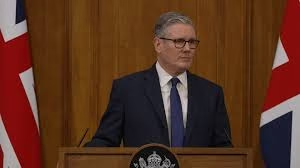
UK Moves Toward EU Rule Alignment, Sparking Political Debate
📰 UK Moves Toward EU Rule Alignment, Sparking Political Debate
🇬🇧 Government Pushes “UK–EU Reset”
Prime Minister Keir Starmer has unveiled a new plan aimed at rebuilding the United Kingdom’s relationship with the European Union. The proposal, described as a “UK–EU reset,” seeks to align certain British regulations with EU rules, particularly in areas such as trade, food standards, and environmental policy.
The government argues that closer alignment will help reduce trade barriers, support businesses, and strengthen the UK economy in the post-Brexit era.
⚙️ Proposed Law and “Henry VIII Powers”
At the center of the plan is a proposed law that would allow ministers to adopt or update regulations in line with EU standards more efficiently. This includes the use of so-called “Henry VIII powers,” which enable the government to amend legislation without requiring a full parliamentary vote each time.
Supporters say this approach will speed up decision-making and make it easier for the UK to respond to changing global economic conditions.
💷 Economic Motivation Behind the Policy
The move comes amid ongoing economic pressures and global uncertainty. By aligning with EU standards, the government hopes to:
- Simplify cross-border trade
- Reduce costs for exporters and importers
- Improve overall economic stability
Officials insist that the plan is a practical economic strategy, not a reversal of Brexit.
⚖️ Strong Opposition from Brexit Supporters
However, the proposal has triggered significant backlash, especially from pro-Brexit figures such as Nigel Farage.
Critics argue that:
- Aligning with EU rules undermines UK sovereignty
- It weakens the outcome of the Brexit referendum
- Granting ministers extra powers reduces democratic accountability
Some opponents have labeled the move a “backdoor attempt” to bring the UK closer to EU control without public approval.
🌍 Not a Return to EU Membership
The government has clarified that the UK will not rejoin the EU or the single market. Instead, the plan focuses on selective alignment in key sectors where cooperation is seen as beneficial.
According to officials, this balanced approach allows the UK to maintain independence while still gaining economic advantages from closer ties with Europe.
🔍 A Nation Divided on Europe
The proposal highlights the continuing divide in British politics over Europe. While some see closer EU cooperation as essential for economic recovery, others view it as a step backward from the independence gained through Brexit.
As the debate intensifies, the future of UK–EU relations remains a central issue shaping the country’s political and economic direction.









Post Comment